
Conference Venue

Heidelberg is one of Germany’s most beautiful and romantic cities, located in the southwest of the country along the Neckar River. It is best known for its well-preserved Old Town, the oldest university in Germany, and the impressive ruins of Heidelberg Castle, which rise above the city and offer spectacular panoramic views. The historic Old Town features narrow cobblestone streets, baroque architecture, lively market squares, and the famous Old Bridge, creating a charming and welcoming atmosphere. Visitors can enjoy a wide variety of cafés, traditional restaurants, and small shops, all set against a scenic backdrop of forested hills. Thanks to its large student population, Heidelberg combines centuries of history with a vibrant cultural life. Museums, theaters, and festivals enrich the city throughout the year, while nearby nature trails and river cruises provide opportunities for relaxation. With its unique blend of history, culture, and natural beauty, Heidelberg is an unforgettable destination for travelers.
The conference venue for IEEE SOCC 2026 is Heidelberg University, respectively its “New University” building. It is only “new” according to the standards of Heidelberg University, and was actually built in the early 20th century.
The New University and Old University of Heidelberg are conveniently located next to each other in the historic old town, in short walking distance to the Neckar River and Heidelberg's most famous sights.
The New University building, constructed by Carl Grube in 1931-34, is a soberly utilitarian structure. Its construction was made possible by the then American ambassador, Jacob Gould Schurman, who organized a campaign in the United States to collect donations for this purpose. The only artful decoration it offers is a sculpture of Pallas Athene above the main entrance, with a caption penned by the scholar Friedrich Gundolf: “To the living spirit”. The courtyard of the New University holds the Witches’ Tower (Hexenturm), the only surviving and once strongest part of the town’s medieval fortifications.
The Old University building was built between 1712 and 1728 on behalf of elector Johann Wilhelm and was called “Domus Wilhelmiana” in his honour. The Old University houses the Rector’s Office as well as the university museum, which was established in 1996. The historic student prison (Studentenkarzer) is located in the back of the Old University.
Conference Banquet Dinner Venue
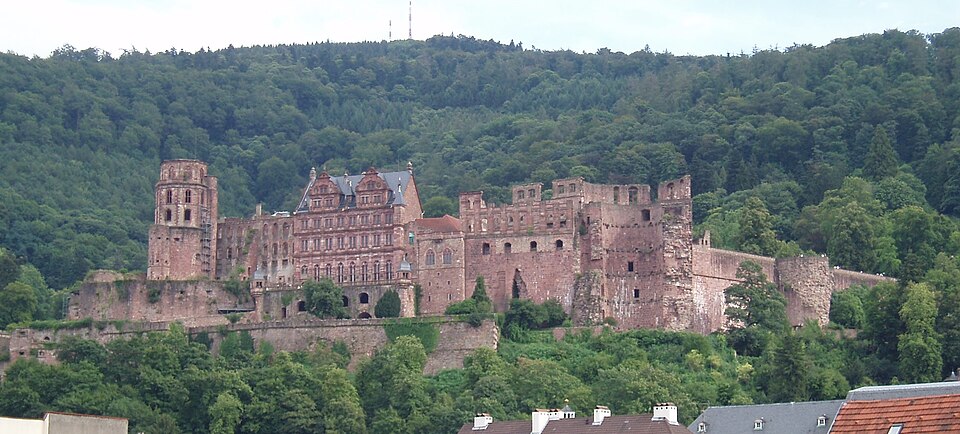
The SOCC 2026 Banquet Dinner event will take place at the historic Heidelberg Castle, on Thursday, Oct. 1. After a guided tour through the castle, we will meet for a reception on the "Altan" (Terrace), from where you will have a spectacular view over the old town of Heidelberg and the Neckar river, followed by dinner in the "Königssaal" (King's Hall). The Banquet Dinner event is included in the full (non-student) conference registration. Extra tickets for students, spouses, accompanying persons, etc. can be bought through the SOCC registration site on EDAS.
Activities
Usually, early October is a beautiful month to visit Heidelberg, and there are plenty of options for activities available, including the various historical points of interest, hiking in the hills, river cruises, or simply strolling the old city and admiring the historical architecture.
Comprehensive information about the main attractions, activities, events and restaurants can be found here: https://www.heidelberg.de/english/Home/Visit.html, or refer to the end of this page for a summary.
How to get there
Heidelberg is easy to reach. Centrally located in Germany, it can be reached by plane, bus and train, or car.
Arriving by air:
The closest international airport is Frankfurt Airport (FRA), the busiest airport in Germany, also serving as the main hub for Lufthansa, and a destination of all major international airlines. Additionally, there are a couple of smaller airports around Heidelberg, such as Stuttgart (STR), Frankfurt Hahn (HHN), or Karlsruhe/Baden-Baden (FKB).
Frankfurt Airport is just 60 minutes away from Heidelberg by train (most recommended, see below), or by car.
An overview of different ways to travel from Frankfurt Airport to Heidelberg can also be found here.
Many hotels also provide an airport shuttle service, while the estimated taxi fare is 150 EUR (one way).
By train:
There are frequent trains running to Heidelberg from all over Europe. For timetables and tickets, refer to German Rail (Deutsche Bahn) or privately owned Flixbus/Flixtrain.
By car:
All the major car rental companies are located at Frankfurt Airport. From Frankfurt Airport take the A5 freeway south (Darmstadt-Karlsruhe/Basel), take exit #37 at the Heidelberg freeway junction to A656/B37 to Heidelberg, and follow the signs to city center. For parking in the city, follow the parking guidance system.
Accommodation
Here are some examples for hotels in walking distance to the conference venue. There are many more hotels in the city center, from low budget to luxury.
Hotel | Room Rate* | Address | Distance to Venue |
|---|---|---|---|
Europäischer Hof | € 345 | Friedrich-Ebert-Anlage 1 | 950m |
Hotel Panorama | € 231 | Bismarckstr. 19 | 1.3km |
Hilton Heidelberg |
€ 220 |
Kurfürsten-Anlage 1
|
1.2km |
NH Collection | € 205 |
Bergheimer Str. 91 | 1.9km |
Exzellenz Hotel |
€ 163 |
Kurfürsten-Anlage 1
|
1.4km
|
Premier Inn Heidelberg City | € 110 |
Kurfürsten-Anlage 23 |
1.7km
|
ibis Heidelberg Hauptbahnhof
|
€ 95 |
Kurfürsten-Anlage 1
| 2.4km
|
*lowest rates according to tripadvisor - actual rates may differ
Map
Selected Local Attractions
Heidelberg, as former residence of the Electorate of the Palatinate, has a rich history and is popular for its baroque old town. Within walking distance, SOCC 2026 attendees can reach the most popular attractions, such as:
- Heidelberg Castle: World-famous and a byword for German Romanticism. The castle looks over the entire city of Heidelberg and the Neckar Valley. For five hundred years it was home to the Prince Electors of the Palatinate who elected the Holy Roman Emperor, ranking them among the most significant secular Princes of the Holy Roman Empire, but then the castle and its garden were destroyed several times during the Thirty Years’ War and the Palatine War of Succession. The castle is surrounded by a beautiful park, where the famous poet Johann Wolfgang von Goethe once walked.
- Old Bridge: Built of Neckar valley sandstone in the 18th century by Prince Karl Theodor, the famous Old Bridge (Alte Brücke) is one of the last large examples of classical stone bridge building. On the city side is the medieval Bridge Gate, part of the former city wall. West of the Bridge Gate, the Heidelberg Bridge Monkey now holds a mirror up to those who look at it. The bronze sculpture was installed there in 1979. But there was a bridge monkey in Heidelberg as far back as the 15th century. Old drawings of the town show it next to the tower on the north end of the Old Bridge. The legend surrounding this curious statue tells us that it symbolizes the fact that neither the city-dwellers nor the people who lived outside the city were better than the other, and that they should look over their shoulder as they cross the bridge to remember this.
- Philosophers’ Walk: Following the old bridge from the old town, there is the Philosophers’ Walk. The name “Philosophers’ Walk” can be traced to the fact that Heidelberg’s university professors and philosophers found this path a congenial place where they could talk seriously and contemplate while enjoying the charming view of the Neckar. This view of the town inspired also the poets Eichendorff and Hoelderlin on their walks to write their poems. Even today, this world-famous path offers new sights and insights. Enjoy a beautiful view of Heidelberg and a climate that reminds you of the Italian Tuscany. Many sub-tropical plants flourish in the “Philosophengaertchen”.
- Old University: Text books here are meant to be “semper apertus - always open”, and the research work of the Ruperto Carola University, founded in 1386, is “geared to the future, yet grounded in tradition”. These requirements have been fulfilled in scientific practice by many prominent scholars over the centuries. Great names characterize the history of Germany’s oldest university, from Hegel to Jaspers, from Bunsen to Bosch. Around 30,000 students are currently enrolled in 12 faculties and 14 special research areas. Core competencies lie in the field of life science.
Within a day trip there are many more attractions to be visited, such as the Schwetzinger Palace and its Gardens, Neckarsteinach and its four castles (can be reached by boat), Mannheim with its second biggest baroque castle in Europe and birthplace of both, bicycle and car. One of the first major car demonstrations was Bertha Benz’s trip by car in 1888 to Pforzheim, which can actually easily be repeated. At least in today’s standards, and only as close as possible to the original route: http://www.bertha-benz.de/indexen.php?inhalt=home
For those interested in hands-on technological history, there are two major technology museums in the area, the Technik Museum Sinsheim and its sister Technik Museum Speyer, with exhibits ranging from historic mechanical devices to submarines, trains, and even large planes like a Concord, Boeing 747, that you can actually enter.